
Read the Bible in 2023 ◊ Week 16: Monday
 Then Moses called for all the elders of Israel and said to them, “Bring out and take for yourselves lambs according to your families and slaughter the Passover lamb. And you shall take a bunch of hyssop and dip it in the blood which is in the basin, and touch some of the blood that is in the basin to the lintel and the two doorposts; and none of you shall go outside the doorway of his house until morning. And Yahweh will pass through to smite the Egyptians; and He will see the blood on the lintel and on the two doorposts, and Yahweh will pass over the doorway and will not allow the destroyer to come into your houses to smite you. And you shall keep this event as a statute for you and your children forever.”
Monday’s Bible reading is Exodus 9–12. Today’s chapters contain the last six of the ten plagues that God brings on Egypt. The final plague is also the best known of the ten—the death of the firstborn.
The Egyptians endure the plagues of the death of their livestock in the fields, the boils and the hail and fire, and when Pharaoh’s servants hear that the next plague will be locusts, they implore him to let the Hebrews go: “Do you not yet know that Egypt is destroyed?” But Pharaoh refuses. So the locusts come and eat the rest of the plants and fruit that were left from hail. Then the ninth plague comes—a thick darkness that could be felt was over all Egypt for three days.
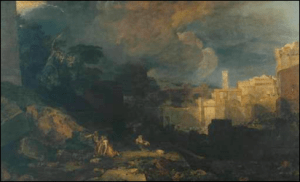 The tenth and final plague is the death of the firstborn of both people and cattle.
 In Exodus 11 and 12, God gives explicit instructions for the first Passover: the Hebrews are to put the blood of a slain, unblemished male lamb on the two doorposts and lintel of their homes.
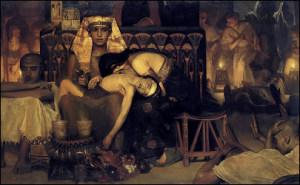 Now it happened at midnight that Yahweh struck all the firstborn in the land of Egypt, from the firstborn of Pharaoh who sat on his throne to the firstborn of the captive who was in the dungeon, and all the firstborn of cattle. Then Pharaoh arose in the night, he and all his servants and all the Egyptians, and there was a great cry in Egypt, for there was no home where there was not someone dead.
John Davis draws these conclusions about the plagues in his book, Moses and the Gods of Egypt, in the section titled, “The Plagues in Perspective.”
“…what were the essential purposes of the ten plagues? First of all, they were certainly designed to free the people of God. Second, they were a punishment upon Egypt for her portion in the long oppression of the Hebrews. Third, they were designed to demonstrate the foolishness of idolatry. They were a supreme example for both the Egyptians and for Israel. It was by these that Jehovah revealed His uniqueness in a way that had never before been revealed (6:3; cf. 10:12). Finally, the plagues clearly demonstrated the awesome, sovereign power of God. In the Book of Genesis, God is described as the Creator of the heavens and earth and all the laws of nature. In the Book of Exodus the exercise of that creative power is revealed as it leads to the accomplishment of divine goals. God’s sovereignty is not only exercised over the forces of nature, but is also revealed against evil nations and their rulers.
“Reflection also causes us to search for practical considerations with regard to these chapters. What effect should the record of these miracles have on our thinking today? Two important considerations may be suggested with regard to these miracles and the God who performed them. First of all, we should always remember that the same God who humbled Pharaoh, the people of Egypt and their gods, is the same God who rules our world. Even though the nations will rage in rebellion against God with their Hitlers and Mussolinis, we are assured of the fact of God’s sovereign preeminence over the affairs of men. Second, and perhaps the most significant, this same God is our Father. A personal relationship with Jesus Christ assures us of the fact that this God looks upon us not in judgment, but in mercy, a thought that should thrill the heart of every Christian. The plagues therefore, are testimony to the power of God, His willingness to deliver, and His ability to perform that which He has promised.”1
The tenth and final plague of the death of the firstborn of both people and cattle was the most significant in God’s demonstration of His power and sovereignty. His deliverance of the Israelites was marked by the Passover feast that God commanded to be remembered and celebrated as a perpetual statute.
The tenth and final plague was the most significant as it looked forward to Jesus Christ, the Lamb of God. Edmund Clowney writes, “it was a symbol of God’s final salvation from all sin and death.”2

The Passover lamb was slain so that God would pass over the people of a house marked with blood and not visit them with a judgment of death. For those who believe in Jesus Christ, He is our Passover Lamb, slain for us so that God does not visit us with the judgment of eternal fire we deserve for our sins.

Silvesterzug Laterne: Bk muc. (CC BY-SA 4.0).
The Signs on the Door: James Tissot. Public Domain.
First Born Plague: J. M. W. Turner. Public Domain.
Death of the Pharaoh’s firstborn son (Ex. 12:29): Lawrence Alma-Tadema. Public Domain.
Agnus Dei: Francisco de Zurbarán. Public Domain.
1John J. Davis, “An Observance Forever, (Exodus 11–12)”, Moses and the Gods of Egypt: Studies in Exodus (BMH Books, Winona Lake IN: 1971, 1986 Second ed.) 159–160.
2Edmund Clowney, The Message of 1 Peter (InterVarsity Press, Downers Grove IL: 1988) 164–165. In his commentary on 1 Peter, Edmund Clowney discusses Peter’s words on Noah and explains that both the saving of Noah’s family and the exodus of the Hebrews from Egypt are “a symbol of God’s final salvation from all sin and death.”: “Like the exodus liberation, it was a symbol of God’s final salvation from all sin and death. Peter uses the term ‘antitype’ to describe the relation of the new to the old. (3:21; NIV’s verb symbolizes translates the Greek noun antitypos). This use of ‘type’ and ‘antitype’ is itself figurative, drawn from the striking of coins or the impression of seals. ‘Type’ describes either a matrix from which an impression is made or an image created. In the letter to the Hebrews, the typology is vertical. That is, the heavenly realities are called the ‘type’ and the earthly symbolizes the ‘antitype’. The tabernacle in the wilderness was therefore the antitype of the heavenly sanctuary. In Paul’s letters and here in 1 Peter, the typology is horizontal in history: the Old Testament is the type, and therefore Christ’s fulfillment is the antitype.”
I’m using Michael Coley’s Bible reading plan (one page PDF to print) to read through the Bible in 2023. Each day my posts are on different books because he divides Bible readings into seven categories, one for each day of the week: Epistles, The Law, History, Psalms, Poetry, Prophecy and Gospels. There’s more information on his plan and other ones at Read the Bible in 2023.
Copyright ©2021–2023 Iwana Carpenter
 Kindling for Candles