
Read the Bible in 2023 ◊ Week 22: Wednesday
 There will be silence before You, and praise in Zion, O God,
And to You the vow will be performed.
O You who hear prayer,
To You all men come
Today’s Bible reading is Psalms 63–65. Remember to pray and ask God to teach you and help you from His Word.
As you read these psalms of David, think about how they reveal who God is. Look at what David says to God and when he says it. Derek Kidner writes this about Psalm 63:
“Once more the worst has brought out David’s best, in words as it did in deeds. The title in the canonical text identifies the desolate scene which set these thoughts in motion., and the mention of the king in verse 11 points to the time when Absalom rather than Saul had made him take to the Wilderness of Judah on his way to the Jordan (cf. 2 Sa. 15:23).”1
David is in a desolate place being hunted by his own son, yet this psalm resonates with gratitude as he focuses on God: who He is and what He has done:
My lips will laud You.
Thus I will bless You as long as I live;
I will lift up my hands in Your name.
My soul is satisfied as with fatness and richness,
And my mouth offers praises with lips of joyful songs.
In Psalm 64 David opens with praying for deliverance. Kidner writes:
“While Psalm 63 was focused on God, with the enemy on the edges of the picture, here the composition is reversed, although the outcome is the same. In fact the brevity of God’s countermeasures, after the elaborate scheming of the wicked, tells its own decisive tale.”2
There is only one verse that speaks of what God will do to David’s enemies! David closes the psalm by describing reactions to God’s work:
And they will declare the work of God,
And will consider what He has done.
The righteous man will be glad in Yahweh and will take refuge in Him;
And all the upright in heart will boast.
 In the last psalm for today, David recounts all that God has done, first, in God’s provision of forgiveness of iniquities, and then in God’s provision for man’s needs.
And Your paths drip with richness.
The pastures of the wilderness drip,
And the hills gird themselves with rejoicing.
The meadows are clothed with flocks
And the valleys are covered with grain;
They make a loud shout, indeed, they sing.
Look again at verse 5.
You who are the trust of all the ends of the earth and of the farthest sea;
David says that God is the trust of all the ends of the earth. As you finish reading, think about that. What do these three psalms teach you about David’s trust in God? Why does David trust Him? How does David’s trust in God affect David when he is hunted by enemies and when he is at ease reflecting on the bounty he sees?
In Exodus 33–36: God’s Goodness & Glory I quoted these verses from Jeremiah 9:
How did David’s knowledge of God undergird his trust in God? We all need to grow in our trust in God. Are there areas in your life or circumstances that are especially difficult for you right now? Spend time in prayer asking God to help you to understand and know Him. Ask Him for help and deliverance in whatever you are facing and for help in trusting who He is and what He will do. Thank Him for His protection and provision for you.

For a brief overview of the structure and poetry of Psalms see my post, The Five Books of Psalms.
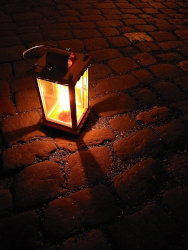
Silvesterzug Laterne: Bk muc. (CC BY-SA 4.0).
Sheep in the Highlands: Rosa Bonheur. Public Domain.
1,2Derek Kidner, Psalms 1–72, (Inter-Varsity Press, London, England: 1973) 224, 227.e, Scotland, U.K. 2016) 10.
I’m using Michael Coley’s Bible reading plan (one page PDF to print) to read through the Bible in 2023. Each day my posts are on different books because he divides Bible readings into seven categories, one for each day of the week: Epistles, The Law, History, Psalms, Poetry, Prophecy and Gospels. There’s more information on his plan and other ones at Read the Bible in 2023.
Copyright ©2011–2023 Iwana Carpenter
 Kindling for Candles