
Read the Bible in 2023 ◊ Week 23: Saturday
 Which of these three do you think proved to be a neighbor to the man who fell into the robbers’ hands?”
Today’s Bible reading is Luke 9–10. Before you begin to read, remember to ask God to teach you from His Word.
There is so much going on these chapters in Luke. They are packed with significant events. Jesus sends out the twelve, and later seventy men to proclaim the kingdom of God. He performs miracles, including the miracle of feeding the five thousand with five loaves and two fishes, Peter’s confession of Jesus as the Christ, the Transfiguration, interaction and teaching with the disciples and the crowds, the sending of the seventy, a parable, and the well-known passage on Martha and Mary. The last three are unique to Luke’s Gospel.
I want to focus on the parable in Luke 10, The Good Samaritan. This parable and The Prodigal Son in Luke 15, are the best known and the most beloved of all of the parables Jesus told. Both parables speak deeply to our hearts, because both parables speak profoundly of our relationships. The love of God is so evident in The Prodigal Son—God’s love for us draws forth from us love for Him; a love of all our heart, soul, strength and mind for Him, the first and greatest commandment. The second command, to love our neighbor as ourselves, flows from the first, and this love is so evident in The Good Samaritan.
This is how the conversation began that prompted Jesus to tell The Good Samaritan.
The translator notes for the Legacy Standard Bible give us this insight into the question asked by the Lord Jesus.
“The translation, “How do you read it?” faithfully accounts for the active verb “read” in the phrase πῶς ἀναγινώσκεις (pōs anaginōskeis). This puts emphasis on the man himself, as Jesus wants him to compare “what is written” to “how he reads,” as Jesus asks not only for the text of the Law, but how the man interprets it. The man only answered the first question (v. 27) while Jesus exposed his misunderstanding of the application (vv. 28–29) and began to teach not only what the Law says, but what it means and how it should be applied (vv. 30–37).”1
Notice why this lawyer asked “Who is my neighbor?”
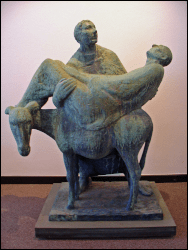 “But a Samaritan, who was on a journey, came upon him, and when he saw him, he felt compassion. And he came to him and bandaged up his wounds, pouring oil and wine on them, and he put him on his own animal, and brought him to an inn and took care of him. And on the next day he took out two denarii and gave them to the innkeeper and said, ‘Take care of him, and whatever more you spend, when I return I will repay you.’ Which of these three do you think proved to be a neighbor to the man who fell into the robbers’ hands?”
Jesus took the lawyer’s question, “Who is my neighbor?” and turned it on its head in Luke 10:29, when he asked, “Who proved to be a neighbor?”2 The Good Samaritan was both rebuke and teaching to the lawyer who sought to justify himself.
Enmity between the Jews and the Samaritans went back hundreds of years, and to use a Samaritan as an example of one who fulfilled the second command in contrast to the priest and Levite, was indeed a reproach that exposed the heart and motivation of the questioner.
I’ve wondered if Jesus chose the Samaritan as the one who showed compassion, not only to underscore the hardheartedness of the religious leaders, but also because a Samaritan would have known what it was to suffer and to need compassion. I’m also fascinated that of the ten lepers healed by Jesus, the only one who came back and thanked Him was a Samaritan. (This was another event that is unique to Luke).
The Good Samaritan. The parable became a theme in many of my posts from the very first year I started Kindling for Candles, I’ve used the photo of the statue of The Good Samaritan in nine unique posts! That wasn’t planned. I think it became a theme because I’ve known both types of people: I’ve had people who reached out and sacrificially gave to me when I was in great need; I’ve also been passed by on the other side.
In Shadow People I wrote about James 2:1–9, and favoritism within the church: those Christians who live in the shadows and remain unreceived and unwelcomed and shut out from the life of the church; those who are patronized and who live without respect because of their circumstances or their background. Rather than being considered rich in faith as James described, the poor of the church are far more likely to be considered inadequate or deficient. These are the people who are hesitant to reach out for help because they struggle with problems or situations they cannot hide. These are the people who love Christ, but who live on the edge of breaking because they bear heavy burdens by themselves. These are people who sometimes finally do shatter under strain.
Have you ever thought how much a kind word or a small consideration can mean? Have you ever thought about why the phrase human touch describes something important, necessary and good? I once had a neighbor, not a Christian, who knew what the hard time I’d been going through, briefly say to me, “Life is tough sometimes, isn’t it?” That meant so much. Her touch of empathy connected to me as a person. With only a few words she conveyed to me support, trust in who I was, and understanding of what I felt.
In Tests I wrote about something I read from a commencement address by J. K. Rowling. She said adversity tests you and your relationships. People who aren’t Christians certainly grasp what it means to be a friend and a neighbor. Christians frequently speak of our testing as individuals by the suffering we endure, but rarely do we discuss how adversity tests and reveals relationships within the church. That’s odd, because Jesus said some emphatic things about our relationships with each other:
Paul, James, Peter, John, and the author of Hebrews all spoke to relationships within the church. When someone you know is going through adversity, he’s not the only one being tested. Your reaction to his adversity is your test. Before you consider him weak, consider yourself.
I’ve written a multitude of posts on Jesus’ command to love one another, but I want to quote from only one, You Shall Not Hide Yourself From Your Neighbor’s Trouble. I’d read Psalm 55:17, and turned to my copy of Derek Kidner’s two volume small-book set of commentaries on the Psalms. As I was reading, I found something unexpected. Kidner titles Psalm 55, “Betrayed” and writes:
“Such a cry as this helps to make the Psalter a book for the extremities of experience as well as for its normalities. The person who is driven to distraction finds a fellow-sufferer here; the rest of us may find a guide to our intercessions, so that we can pray with our brethren ‘as though in prison’ (or other distress) ‘with them’ (Heb. 13:3).”3
The psalm opens with David saying,
And do not hide Yourself from my supplication.
Kidner calls the first three verses, “The intolerable strain.”
“A recurrent phrase in the law of Deuteronomy 22:1–4 (RSV mg.) lights up the plea, hide not thyself, by using this very expression to forbid the ignoring of a neighbor’s predicament, however inconvenient the moment. So the allusion makes David’s prayer an appeal to God’s self-consistency as well as to His mercy.”4
That was the unexpected part—Hide not thyself—God forbids the ignoring of a neighbor’s predicament, however inconvenient. Those words sent me to Deuteronomy.
In the Legacy Standard Bible uses the word ignore, but notes that the Hebrew is literally hide yourself! I’d read that passage in Deuteronomy before, but Kidner’s insight brought new understanding of God’s command to, “Love your neighbor as yourself.”
Think for a minute about God’s command in Deuteronomy, “You shall not hide yourself.” What an apt phrase to describe the way Christians can awkwardly edge away from you, literally hiding themselves away from your trouble because it brings them discomfort. There are few things more painful than experiencing such abandonment.
What does that say about who we are as Christians? Are we children of God? Are we not commanded to love one another? To support and help each other? Rather than abandon those in distress or fail to watch out for them or consider how we can help them and then do it, let us instead abandon indifference, excuses, self-justification and self-righteous judgment.
Hiding yourself from your neighbor’s trouble is hiding love that someone needs. I ask you to prayerfully consider and think over the parable of The Good Samaritan.
If you feel as if others are hiding themselves for your trouble, I want to remind you that God will never hide Himself from our trouble. Even when others do so, He will not. We may feel forgotten by others and by Him—David certainly did at times, and his words help and comfort us in our feelings—but as David also knew, God is always there. He does not hide Himself from our trouble, He hides us in our day of trouble.
In the secret place of His tent He will hide me;
He will lift me up on a rock.
One of my favorite hymns in Fanny Crosby’s “He Hideth My Soul.” The day after I learned my brother had tried to commit suicide, my pastor, Mike Braun, had our church sing this hymn. I’d called Mike when I heard and he spent time with me that Sunday morning before church. I was shattered, and these words brought immense comfort. God does not hide Himself from you. He will hide you with His love and care in your day of trouble.
In that time, God not only comforted me with His comfort, but so many in that church comforted me, stood with me, and did not hide themselves from my trouble.
Our English word comfort comes from a Latin word meaning “to strengthen much”—notice the word fort within it. You can either remain within the stronghold of your own life or you can bring people in within walls of shelter. You can either comfort or remain comfortable. I am so very, very grateful for the Christian brothers and sisters who gave of themselves then, and over the years have so many times given comfort to me.
Life in this world can be messy, inexplicable, and outside our control because we live in a world marred by sin. Have you come to realize that God in His sovereignty has allowed it to be that way, and that only He is in control? Do you distance yourself from those who live in messy situations because you only want to deal with things that can be quickly tidied and neatly boxed up?
Some people do have a spiritual gift of mercy. They are especially sensitive and compassionate, and very practical about what to do to help someone who is suffering. All of us, however, should be aware and ready to act to help those people in our lives who suffer.
A man once asked the Lord Jesus, “Who is my neighbor?”
Who is yours?

Silvesterzug Laterne: Bk muc. (CC BY-SA 4.0).
Barmhartige Samaritaan (The Good Samaritan): Han Wezelaar. Gouwenaar. Public Domain. Retrieved 11 June 2023.
1Luke 10, Legacy Standard Bible Translation Notes. The Tyndale Center at The Master’s Seminary.
2Robert L. Thomas and Stanley N. Gundry, A Harmony of the Gospels (HarperSanFrancisco, San Francisco CA: 1978) 137. “(Luke 10:36) Jesus rephrased and corrected the lawyer’s question from, “Who is my neighbor”? (v. 29) to “To whom am I a neighbor?” This note prompted my thinking and phrasing of this sentence.
3,4Derek Kidner, Psalms 1–72 (Inter-Varsity Press, London: 1973) 199, 199.
Read Holding Fast for help on recognizing when someone has troubles.
Read Suffering & Lovingkindness on showing love to someone suffering in troubles.
Read Journey Through The Storm to better understand those in the midst of troubles.
I’m using Michael Coley’s Bible reading plan (one page PDF to print) to read through the Bible in 2023. Each day my posts are on different books because he divides Bible readings into seven categories, one for each day of the week: Epistles, The Law, History, Psalms, Poetry, Prophecy and Gospels. There’s more information on his plan and other ones at Read the Bible in 2023.
Copyright ©2011–2023 Iwana Carpenter
 Kindling for Candles