
Read the Bible in 2023 ◊ Week 25: Monday
 “‘Thus the priest shall make atonement for him in regard to his sin which he has committed, and he will be forgiven.’”
In Monday’s Bible reading of Leviticus 4–6, God gives instructions for sin offerings in Leviticus 4:1–5:13; guilt offerings, Leviticus 5:14–6:7; and begins commandments to the priests in Leviticus 6:8.1
As you read Leviticus, you’ll probably noticed guilt/guilty and blood are repeated words, as is the phrase, the priest shall make atonement. Watch also for the word forgiven. These words: guilt/guilty, blood, atonement, and forgiven, are found more often in Leviticus than in any other book in the Bible.
Gleason Archer writes:
“The basic principle underlying all the blood sacrifices (zebāḥīm) was atonement (kippūr) by the substitution of an innocent life for the guilty. In token of this substitution, the offerer laid his hand upon the victim’s head, thus identifying himself with it as his representative. To signify his acceptance of the just penalty of death, the offerer himself slew his victim and then turned it over to the priest for the completion of the ceremony. The priest usually sprinkled or smeared a portion of the blood upon the altar.”2
Remember God had told Adam:
And Paul wrote:
 The sacrificial system taught Israel day in and day out that sin always results in death, and that God accepted “the substitution of an innocent life for the guilty.”
Laird Harris states kōper, ransom, is a parent noun of kāpar, make an atonement.3
“This word “ransom,” is parallel to the word “redeem,” …in Ps. 49:7.
“From the meaning of kōper “ransom,” the meaning of kāpar can be better understood. It means “to atone by offering a substitute.” The great majority of the usages concern the priestly ritual of sprinkling the sacrificial blood thus “making an atonement” for the worshipper. There are forty-nine instances of this usage in Leviticus alone and no other meaning is there witnessed.”4
The Hebrew word for atonement, kippūr, ‘is used today in the name of the Jewish holiday yom kippur “day of atonement” (used only in the plural in the OT).’5 Leviticus 16 will explain God’s commandments regarding this one day of the year when the high priest entered the Holy of Holies to make atonement.
Notice that the substitutionary death of the sacrifice for atonement of sin in Leviticus 4–6 is followed by the closing phrase …and he will be forgiven.
As you read about these Old Testament sacrifices, Victor Hamilton makes an important point:
“…blood in the OT denotes not life, but death, or more accurately, life that is offered up in death. Having said this, it should be pointed out that there is absolutely nothing in the OT akin to the morbid preoccupation with the sinister deities of the netherworld such as one finds in the blood rituals of Israel’s neighbors…”6
Last week I quoted Oswald Allis: “…there is no book in the OT which more clearly sets forth the redemption which is in Christ than does Leviticus.”7 The book of Hebrews points us back to Leviticus and its purpose:
And in stark contrast to the day in and day our sacrifices in Leviticus, the writer of the book of Hebrews emphasizes over and over that Christ’s sacrifice for our sin was once—one sacrifice for sins for all time.

Silvesterzug Laterne: Bk muc. (CC BY-SA 4.0).
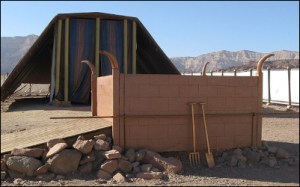
Altar of Burnt Offerings, Model of the tabernacle, Timna Valley Park, Israel: Ori229. (CC BY-SA 3.0). GFDL-1.2-or-later.
1Derek Kidner, Leviticus, Numbers and Deuteronomy, Scripture Union Bible Study Books (William B. Eerdmans Publishing Company, Grand Rapids MI: 1971) 7–9.
2Gleason L. Archer, Jr.,, “Leviticus and Numbers,” A Survey of Old Testament Introduction (Moody Press, Chicago IL: 1974) 243.
3,4,5R. Laird Harris, “1023 כָּפַר (kāpar) make an atonement; 1023a כֹּפֶר (kōper) ransom; 1023 כִּפֻּר (kippūr) (used in the plural kippūrîm) (atonement),” Theological Wordbook of the Old Testament, vol. I, R. Laird Harris, Gleason L. Archer, Jr., Bruce K. Waltke, eds. (The Moody Bible Institute, Chicago IL: 1980) 452, 453, 453.
6Victor P. Hamilton, “436 דָּם (dām) blood,” Theological Wordbook of the Old Testament, vol. I, R. Laird Harris, Gleason L. Archer, Jr., Bruce K. Waltke, eds. (The Moody Bible Institute, Chicago IL: 1980) 191.
7Oswald T. Allis, “Leviticus,” The New Bible Commentary: Revised, D. Guthrie, J. A. Motyer, eds., A. M. Stibbs, D. J. Wiseman, contributing eds. (Inter-Varsity Press, Downers Grove IL: 1970) 142.
I’m using Michael Coley’s Bible reading plan (one page PDF to print) to read through the Bible in 2023. Each day my posts are on different books because he divides Bible readings into seven categories, one for each day of the week: Epistles, The Law, History, Psalms, Poetry, Prophecy and Gospels. There’s more information on his plan and other ones at Read the Bible in 2023.
Copyright ©2011–2023 Iwana Carpenter
 Kindling for Candles