
Read the Bible in 2023 ◊ Week 25: Tuesday
 Now it happened when Ahab saw Elijah, that Ahab said to him, “Is this you, you troubler of Israel?”
Tuesday’s Bible reading is 1 Kings 14–18. These chapters continue the record of Rehoboam, king of Judah, and Jeroboam, king of Israel and the successors to their thrones. It’s a woeful tale of conspiracy, rebellion, slaughter, and war. With the exception of Asa, a king of Judah, it’s a story of idolatry, religious prostitution, and leading the people into sin against God. (Click here for the chart, Genealogy of the Kings of Ancient Israel and Judah).
Ahab and Jezebel are introduced in these chapters—a king and queen of Israel whose notoriety made them familiar to this day—and the name Jezebel is still synonymous with an immoral woman. Their lives are intertwined with one of the most famous of all of the prophets of Israel: Elijah.
1 Kings 17 – 2 Kings 1:18 is called the Elijah cycle and 2 Kings 2–10:26 is the Elisha cycle because these two sections are the records of the two prophets.1 William LaSor has these comments about Elijah:
“Elijah, who is to the prophets as Moses is to the law, is presented to us without introduction other than that he is called ‘Elijah the Tishbite’. Yet it is obvious that there must have been quite a history of his activities before the event in 17:1. Ahab called him the ‘troubler of Israel’ (18:17). Obadiah, the household steward of Ahab, refers to the fact that they had sought out Elijah everywhere (18:10). The reputation of mysterious disappearances is hinted at in 18:12. .Certainly there had to be an anterior reputation for Elijah to create such an effect upon Ahab, particularly for Ahab to take seriously the prophecy of drought in 17:1…One measure of his stature is to be found in the fact that he was the man raised up by God at the time that Baal worship threatened the very existence of the worship of Yahweh in Israel. His place in the NT also underscores his importance. The forerunner of the Christ was to come in the spirit and power of Elijah (Lk. 1:17). Moses and Elijah, as representatives of the law and of the prophets, stood with Jesus on the Mount of Transfiguration (Mt. 17:3; Lk. 9:31)…Skinner says of Elijah, ‘He is to be ranked as the greatest religious personality that had been raised up since Moses’.”2
1 Kings 17–18 contains miracles done by Elijah as well as the enthralling story of his great confrontation with 450 prophets of Baal in chapter 18.
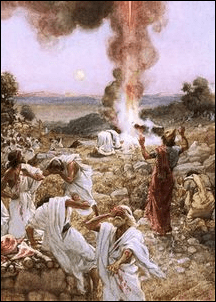 Now it happened at the time of the offering of the evening sacrifice, that Elijah the prophet came near and said, “O Yahweh, the God of Abraham, Isaac and Israel, today let it be known that You are God in Israel and that I am Your slave and I have done all these things at Your word. Answer me, O Yahweh, answer me, that this people may know that You, O Yahweh, are God, and that You have turned their heart back again.”
LaSor writes:
“The contest with the prophets of Baal on Mt. Carmel is one of the most dramatic stories in the OT. Historically, we could say that it saved Yahweh-worship in Israel. In view of the subsequent marriage-alliance between Israel and Judah, we might even extend this to say that the knowledge of the Lord in both Israel and Judah could have been wiped out forever if the Lord had not raised up Elijah at this moment. The contest was not to demonstrate which of two gods was greater, but to demonstrate which was the true God and the other no god at all.”3
Elijah is mentioned numerous times in the New Testament. There are referenences to him in each of the four Gospels, Paul mentions him in Romans, and when James describes the many occasions in which we’re to pray, he tells us Elijah was a man with a nature like ours, and he encourages us to pray using the example of Elijah’s prayers for drought and rain.
That’s incredible—may we understand, as Elijah did, that the Lord, He is God, and be encouraged to pray and live accordingly.

Silvesterzug Laterne: Bk muc. (CC BY-SA 4.0).
Elijah’s Sacrifice At Mount Carmel: William Brassey Hole. Public Domain.
1,2,3William Sanford LaSor, “1 and 2 Kings,” The New Bible Commentary: Revised, D. Guthrie, J. A. Motyer, eds., A. M. Stibbs, D. J. Wiseman, contributing eds. (Inter-Varsity Press, Downers Grove IL: 1970) 341, 349; 341–342; 343.
I’m using Michael Coley’s Bible reading plan (one page PDF to print) to read through the Bible in 2023. Each day my posts are on different books because he divides Bible readings into seven categories, one for each day of the week: Epistles, The Law, History, Psalms, Poetry, Prophecy and Gospels. There’s more information on his plan and other ones at Read the Bible in 2023.
Copyright ©2021–2023 Iwana Carpenter
 Kindling for Candles