
Read the Bible in 2023 ◊ Week 26: Sunday
 Paul and Timothy, slaves of Christ Jesus,To all the saints in Christ Jesus who are in Philippi, with the overseers and deacons: Grace to you and peace from God our Father and the Lord Jesus Christ.
Sunday’s Bible reading is Philippians 1–2. Luke’s account in Acts 16 of the beginning of the church at Philippi is dramatic and well-known. Luke records Paul’s vision of the man from Macedonia appealing, “Come over to Macedonia and help us.” Paul, Silas, and Timothy arrive in Philippi, the leading city of Macedonia, and Luke describes the conversion of Lydia and the imprisonment of Paul and Silas: their prayers and singing, the earthquake with prison doors opened and chains unfastened, and the conversion of the Philippian jailer and his household.
In the very first verses of this letter, Paul identifies himself as a slave of Christ Jesus and writes of his joy in the Philippians. These opening words to the church in Philippi set the tone for the entire letter, for Philippians is an epistle of service and joy.
Paul’s love for Christ and love for his fellow believers in Christ, and the joy that is a fruit of that love are seen throughout these four chapters. Paul urges and exhorts the Philippians to love and serve one another, following Christ’s example. The example of our Lord Jesus Christ is found in Philippians 2:5–11, the heart of this letter.
Jesus Christ was “truly man and truly God.” J. A. Motyer has this translation of Philippians 2:5–8.
Motyer explains:
“When Paul says that Christ Jesus was in the form of God, that is, in full possession of the divine nature, he underlines the fact by using, not the simple verb ‘to be’, but a stronger verb which in its characteristic usage has the force ‘to be really and truly’. ‘to be characteristically’, even ‘to be by nature’. In a passage like the present one, where it is plain that every word has been weighed and measured, the full meaning of the verb can be assumed: he was really and truly, in his own personal and essential nature, God.
“But, being so, he emptied himself. The very notion of ’emptying’ inevitably suggests deprivation or lessening, the loss of something that was possessed before. When Jesus emptied himself, did he diminish himself, and if so, in what way? Here is a thought which must obviously be handled with care.
“It is helpful to note, in the first place, the fact that the verb ‘to empty’ in every other New Testament instance means to deprive something of its proper place and use.’. ‘Christ, indeed,’ says Calvin, ‘could not divest himself of Godhead; but he kept it concealed for a time . . . he laid aside his glory in the view of men, not by lessening it, but by concealing it.’…
“Secondly, we ought to notice that in asking the perfectly natural question, ‘Of what did Christ Jesus empty himself?’, we are, in fact, departing from the direct line of thought in this passage. For the verb emptied is at once followed by an explanatory clause, taking the form of a servant (slave). Our eye, in other words, is removed from the realm of mystery (the relation between the new incarnate life and the eternal divine life) and focused on the realm of historical factuality, the reality of the eternal God becoming truly man. It is not ‘Of what did he empty himself?’ but ‘Into what did he empty himself?’ While it must be pointed out that this way of putting it arises from the flexibility of the English verb ‘to empty’ and does not reflect the Greek use of kenoō [to empty] in the New Testament, it nevertheless catches perfectly the movement of Paul’s thought: Christ Jesus brought the whole of his divine nature, undiminished, into a new and — had it not been revealed to us in Scripture — unimaginable state.
“…It was a true humanity: Paul uses again the word form, already discussed; but this time of the slave-state. The Son became the reality of a bondservant…
“Throughout all this there is the same revelation of the ‘mind of Christ’. His are the eternal glories, both by nature and by right, but they are not a platform for self-display, nor a launching-pad for self-advancement; they are all for self-denial. Self is something to ‘pour out’.”2
In his article, “Slaves of God,” Edwin Yamauchi writes:
“When the Son of God, who clutched not His equality with God but divested Himself of His garment of Glory, came to earth, He donned not the royal robes of a king but the soiled apron of a slave. He who descended from heaven came not to earth’s heights but to its depths. As a faithful Slave He served, and as an obedient Slave he went to that ignominous death, from which Rome exempted her citizens and which she reserved especially for slaves.”3
I think joy is the fruit of our love for Christ, and our love for others that flows from our love for Christ. And our love for Christ, in turn, comes from God’s great love for us—We love, because He first loved us (1 John 4:19).
Not only Paul, but all for whom Christ became a slave, are now slaves of Christ.
Dr. Yamauchi concludes:
“In Juvenal’s Rome “Sons of men freeborn give right of way to a rich man’s slave.” Like that slave we can boast in another’s affluence that is ours to enjoy in the presence of reputedly free men who are beggars by comparison. If this were all, we might be content to simply translate the term doulos Christou as simply “the servant of Christ.”
“But if the title doulos Christou is an appellation of honor as it declares what we are in our relationship to the Sovereign of the Universe, it is also a designation of humility as it reminds us of what we are in ourselves….
“It is also a phrase that reminds us of our ransom from another master at an incredible price. It was not with the fabulous sums of all the royal estates we were bought, nor was it for handsome features or some prized skill we were purchased. But rather unlovely, without any merit, rebellious at heart, we were redeemed with the precious blood of the Master Himself.
“Having thus been bought by Christ we are entirely His….
“Since we are slaves and not aristocratic lords we ought not to deem ourselves too high and mighty to soil our hands with work. The lot of a slave was one of toil. So Paul labored night and day to the point of exhaustion (I Thes. 2: 9). Since we are slaves we can expect the circumscription of our own rights and desires. If we are truly Christ’s bondmen we shall forego these for the sake of serving and saving others (I Cor. 9:19). Since we are slaves we cannot think ourselves worthy of any thanks for what we do (Lu. 17:10). We should be prepared to labor graciously and gratuitously at thankless tasks all our days. Our very lives ought to be expendable.
“Only as we acknowledge that we are indeed the slaves of Jesus Christ and realize in our lives all that this implies, may we hope to hear the Master say at the day of reckoning, “Well done, thou good and faithful slave.”5
The writer of Hebrews spoke of the joy of Jesus enduring the cross.
Paul wrote to the Philippians:

Silvesterzug Laterne: Bk muc. (CC BY-SA 4.0).
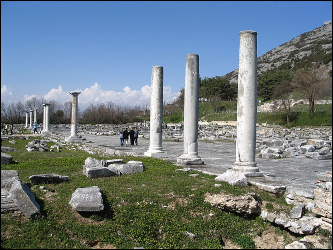
Philippi Agora And Acropolis, “Ruins of ancient Philippi, looking NW along the southern portico (stoa) of the city’s main marketplace (or agora). A roof would have covered the grassy area along the near side of the line of monumental columns. The broad stone-paved area beyond was the open market area. Along the far (northern) side of this market ran the via Egnatia, the main Roman highway through Macedon. In the distance (at right) is visible the acropolis, or high hill, of the city. The Roman inhabitation spread up much of the hill’s SW face.”: Ian W. Scott. (CC BY-SA 3.0). GFDL-1.2-or-later.
1,2J. A. Motyer, The Message of Philippians: Jesus our Joy (InterVarsity Press: Downers Grove IL: 1984) 108, 112–115.
3,4,5Edwin Yamauchi, “Slaves of God,” Bulletin of the Evangelical Theological Society 9.1 (Winter 1966) 47; 46, 46: translations of Galatians 5:13 and 1 Peter 2:16; 48–49. The section, ‘The Word “Slave” and The Translators of The King James Version’ on pages 40–43, is very helpful in understanding why doulos was t,ranslated as servant rather than slave in the KJV New Testament.
I’m using Michael Coley’s Bible reading plan (one page PDF to print) to read through the Bible in 2023. Each day my posts are on different books because he divides Bible readings into seven categories, one for each day of the week: Epistles, The Law, History, Psalms, Poetry, Prophecy and Gospels. There’s more information on his plan and other ones at Read the Bible in 2023.
Copyright ©2011–2023 Iwana Carpenter
 Kindling for Candles