
Read the Bible in 2023 ◊ Week 33: Thursday
 From the fruit of a man’s mouth his stomach will be satisfied;
With the produce of his lips he will be satisfied.
Death and life are in the power of the tongue,
And those who love it will eat its fruit.
Thursday’s Bible reading is Proverbs 17–18. Speech continues to be a theme in this section of the book, “Proverbs of Solomon,” that began in chapter 10.1 As you read mark the verses that address our words. Notice how we use them, and their affect on others.
While I was reading I thought of this verse from James:
This is quite a check on spiritual pride. It’s a quick, but significant, test and really teaches us humility as it convicts us. James returns to the tongue in James 3:1–12, warning teachers, who are great users of their tongue;2 comparing the tongue to a horse’s bit, the rudder of a ship, and writing it is a destructive fire of hell, a restless evil, and a deadly poison. It’s no wonder James declared:
In his commentary on Proverbs, Derek Kidner has a very helpful summary of Proverbs’ teaching on words:
“As many as three out of the seven abominations listed in Proverbs 6:16–19 are examples of the misuse of words: such is their importance in Proverbs. What is taught about them may be grouped under three headings.”4
I found Kidner’s headings and points to be so insightful that I want to list them for you and pull out most of the verses he cites so that you can read them. I’m sure we’ve all been wounded by words, and we’ve also wounded others. If we can grasp and remember that death and life are in the power of the tongue, then we will be more diligent to guard what we say.
I. THE POWER OF WORDS
‘Death and life are in the power of the tongue.’ Proverbs 18:21. This power springs from largely two qualities.
1. Penetration. What is done to you is of little account beside what is done in you, and the latter may be for good or ill. The feelings, or morale, may be lacerated by a cruel or clumsy thrust (‘like the piercings of a sword’, 12:18a), and ‘a wounded spirit, who can bear?’ (18:14); equally, they may be vitalized by a timely word (12:18b,25), and the whole body with them (‘sweetness to the soul and health to the body’ 16:24, RSV; cf. 15:30). One’s attitude to another person may be deeply affected by a mere whisper, unforgettable as soon as relished (18:8), and one’s self-esteem ruinously inflated by flattery (which entangles its victim, 29:5, by the craving it induces and by the ill-judged actions it invites). Above all, beliefs and convictions are formed by words, and these either destroy a man or are the making of him (11:9; 10:21).5
 2. Spread. Since words implant ideas in other minds, their effects ramify—again, for good or evil… 16:27b, 28a RSV… 6:14… 10:10; 16:30… 12:14… 10:11 cf.18:4… 15:4.
II. THE WEAKNESS OF WORDS
1. They are no substitute for deeds… 14:23 RSV.
2. They cannot alter facts… 26:23–28… 28:24… 24:12.
3. They cannot compel response… 29:19… hence the appeals to the listener to make his own search for wisdom (e.g. 2:3,4) as for something which the teacher cannot impart to the apathetic… 17:10… The most spicy gossip has power over the listener only in so far as he is himself ‘an evildoer’ and a walking ‘falsehood’, in whom the taste for carrion can overpower the love of truth… (17:4).6
III. WORDS AT THEIR BEST
Proverbs gives teaching on (a) the marks, and (b) the making of such words.
a. The marks of them
1. They will be honest… ‘Righteous lips are the delight of kings’ (16:13)… Cf. 24:24–26, where a ‘right’ answer (26) is literally a ‘straight’ or ‘straightforward’ one. Cf. also 25:12; 27:5 6; 28:23.
2. They will be few… 17:28… 10:14; 13:3… 11:12,13… 10:19.
3. They will be calm… 17:27… Three reasons can be found for this praise of calmness: first, it allows time for a fair hearing (18:13, cf. verse 17); second, it allows time for tempers to cool (15:1: ‘A soft answer . . .’); and third, its influence is potent: ‘a soft tongue breaketh the bone’ (25:15).
4. They will be apt… A truth that makes no impression as a generalization may be indelibly fixed in the mind when it is matched to its occasion and shaped to its task. There is a craftsman’s as well as a recipient’s delight glimpsed in 15:23: ‘To make an apt answer is a joy to a man, and a word in season, how good it is!’ The same aesthetic pleasure glows in the language of 10:20 (‘the tongue of the righteous is as choice silver’) and 25:11 (‘like apples of gold is a settting of silver’); cf. also 25:12; 22:11; 10:32.7
b. The making of them
1. Study. 15:28 states what the foregoing paragraph implies. ‘The mind of the righteous ponders how to answer, but the mouth of the wicked pours out evil things.’ A similar point is made in 15:2. When we add to this the implications of 2:6 and, perhaps, 16:1, we are within sight of the classic statement in Isaiah 50:4 (‘The Lord God hath given me the tongue of them that are taught . . .’).
2. Character. Some of the apparent platitudes of the book (e.g. 14:5; 12:17) arise from its insistence that what a man says wells up from what he is — it will be worth what he is worth. So ‘the tongue of the righteous’ is weighed against ‘the heart of the wicked’, and their values (‘choice silver’; ‘little worth’) are compared directly (10:20). It is put most forcibly in the familiar saying of 4:23: ‘Keep your heart with all vigilance; for from it flow the springs of life.’ It is only a step here to our Lord’s, ‘Out of the abundance of the heart the mouth speaketh’ (Mt. 12:34).8
Look again at these words of the Lord Jesus:
I want to include one other verse from the New Testament regarding our words.
Go back to the verses at the beginning of this post:
With the produce of his lips he will be satisfied.
Death and life are in the power of the tongue,
And those who love it will eat its fruit.
Kidner’s title for these two proverbs is, “Your words will catch up with you.”9 That pulls us up short, doesn’t it?
“The second of this pair of proverbs, with its warning to the talkative, throws a sobering light on the first. Both of them urge caution, for satisfied (20) can mean ‘sated’: the meaning, good or bad, will depend on the care taken.”10
This is a hard battle. I know it, and you know it. Only by God’s help and power can we learn to control our words, for changed words mean first of all a changed heart, and God is the One who changes our heart. May the Lord enable us to daily persevere in giving only grace to others through our words.

For a brief overview of the main divisions of Proverbs see my post, The Book of Proverbs.
Silvesterzug Laterne: Bk muc. (CC BY-SA 4.0).
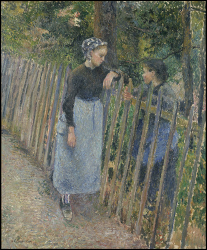
Conversation: Camille Pissaro. Public Domain.
1,4,5,6,7,8,9,10Derek Kidner, Proverbs: An Introduction and Commentary (Inter-Varsity Press, Downers Grove IL: 1965) 57, 46, 46, 47, 48, 49, 130, 130.
2“The teacher uses his tongue constantly and so is in particular peril on this score.” A. T. Robertson, “The Epistle of James,” Word Pictures in the New Testament, Vol. VI (Broadman Press, Nashville TN: 1933, 1960) 39.
3“Perfect signifies “having reached its end” (telos), “finished, complete, perfect.”” W. E. Vine, Vine’s Expository Dictionary of New Testament Words. https://www.blueletterbible.org/search/Dictionary/viewTopic.cfm?topic=VT0002090. Retrieved 15 August 2024.
I’m using Michael Coley’s Bible reading plan (one page PDF to print) to read through the Bible in 2023. Each day my posts are on different books because he divides Bible readings into seven categories, one for each day of the week: Epistles, The Law, History, Psalms, Poetry, Prophecy and Gospels. There’s more information on his plan and other ones at Read the Bible in 2023.
Copyright ©2011–2023 Iwana Carpenter
 Kindling for Candles