
Read the Bible in 2023 ◊ Week 41: Wednesday
The unfolding of Your words gives light;
It gives understanding to the simple.
Psalm 119:130 LSB
Wednesday’s Bible reading is Psalms 119. It’s very fitting that Psalm 119 is the longest chapter in the Bible because in this psalm the writer speaks of his delight and love of God’s Word, he is grateful for its work in his life, and he turns to God for help from His Word over and over again.
And a light to my path.
Alec Motyer describes Psalm 119.
“Psalm 119 is the greatest of the alphabetic acrostic psalms…In this case the theme is what God has revealed to his people: his teaching, his rules, all thought of as his very words, spoken by himself. Almost every verse contains a reference to this basic fact. Likewise, almost every verse is a prayer: possessing God’s word lies in the context of a life ever lived in relationship with him; he speaks in his word, we who possess this word speak to him as we seek to live by what he has spoken. The unknown writer devotes eight verses to each letter of the Hebrew alphabet in turn, but as ever in Hebrew poetry, form is subordinate to meaning. Part of the fascination of Psalm 119 is to observe how, within the apparent rigidity of making eight verses all begin with the same letter, each letter in turn is pressed into service to express the truths and emphases the writer desires.”1
Derek Kidner titles it, ‘The Rich and Precious Jewel’ of the Word2 and writes:
“This giant among the Psalms shows the full flowering of that ‘delight . . . in the law of the Lord’ which is described in Psalm 1, and gives its personal witness to the many-sided qualities of Scripture praised in Psalm 19:7ff.
“It is an acrostic psalm, an alphabet of prayers and reflections on the Word of God, giving each Hebrew letter its turn to introduce eight successive verses on the subject. While different thoughts tend to predominate in different stanzas, partly from the stimulus of the alphabetic scheme, they are mingled with others that constantly recur. The mood is meditative; the poet’s preoccupations and circumstances come to light in prayers and exclamations, not marshalled in sequence but dispersed throughout the psalm…
“Like a ring of eight bells, eight synonyms for Scripture dominate the psalm, and the twenty-two stanzas will ring the changes on them. They will do it freely, not with a bell-ringer’s elaborate formulae, and they will introduce an occasional extra term. But the synonyms belong together, and we should probably not look for each to show its distinct character at each occurrence, but rather to contribute, by its frequent arrival, to our total understanding of what Scripture is.”3
As you read this psalm, think of Kidner’s words, “the poet’s preoccupations and circumstances come to light in prayers and exclamations.” In Organizing Love, I wrote about the preoccupations and circumstances of my friend Lisa and how the Lord used Psalm 119:11 to turn her from bitterness and sin and set her on the path to trusting Him.
That I may not sin against You.
Leslie M’Caw and J. A. Motyer comment:
“This is an elaborate, ingenious and passionate meditation upon the law of the Lord. ‘Law’ in the OT should not be confused with Pharisaic legalism. The Hebrew word is tôrâ, meaning ‘teaching’. It stands for the will of God revealed to Israel. It is the loving instruction of a parent (Pr. 4:1, 2).
“The psalm has an acrostic pattern: each of the twenty-two letters of the Hebrew alphabet is made the initial letter of eight verses in the successive sections. The major feature, however, is the repetition of eight synonyms of the will of God: law (tôrâ), ‘teaching’, notes that God has made His truth known by personal verbal communication, just as a teacher or parent would; this is also expressed by word (dāḇār, or ’imrâ). Testimonies (‘ēḏôṯ) stresses the content; God has testified of Himself and His requirements. These latter come to man as statutes (ḥuqqîm, root ḥ-q-q, to engrave) or unchangeable rules; judgments or ordinances (mišpāṭîm), decisions which God has made; precepts (piqqûḏîm) authoritatively imposed; commandments (miṣwôṯ) expecting obedience; all issuing in a way (derek), habitual modes of life and thought. (Cf. Ps. 19:7ff.) One or other of these terms occurs in every verse of the psalm, except v. 122.”4
Here are the eight synonyms organized into a list for easier reading:
-
- Law (tôrâ), ‘teaching’, God has made His truth known by personal verbal communication, just as a teacher or parent would.
- Word (dāḇār, or ’imrâ) also expresses this.
- Testimonies (‘ēḏôṯ) stresses the content; God has testified of Himself and His requirements.
- Statutes (ḥuqqîm, root ḥ-q-q, to engrave) or unchangeable rules.
- Judgments or ordinances (mišpāṭîm), decisions which God has made.
- Precepts (piqqûḏîm) authoritatively imposed.
- Commandments (miṣwôṯ) expecting obedience
- Way (derek), all issuing in habitual modes of life and thought.
There are numerous verses of Psalm 119 that God has used in my life. When I wrote about Psalm 119 back in 2011, these are two of the verses that described the work of God’s Word in my preoccupations and circumstances of that year. Psalm 119:28 describes why I kept reading and writing about the Bible, and it speaks of the work of God’s Word in me as through it God strengthened me with His comfort and wisdom.
Strengthen me according to Your word.
Psalm 119:92 spoke deeply to my heart because it so well described what would have happened to me without God’s ministry of His Word in my life, not only in 2011, but throughout my life. If you read my Journey Through The Storm, I think you will be able to see this.
Then I would have perished in my affliction.
 What are your preoccupations and circumstances right now? What does the psalmist write in his prayers and exclamations that describe you and your life?
Kidner points out three qualities “ascribed to Scripture”5 in Psalm 119:
“A persistent theme is the delight these sayings bring…
“Deeper than delight is love; and Scripture evokes this abundantly. Here verse 132 goes to the heart of the matter in the expression, ‘who love thy name’. It is on God’s account that we love the writings that reveal Him…
“But if Scripture is attractive and gracious, these qualities are combined with strength. As the voice of God, it is awesome… Strength of a more reassuring kind is expressed in the fact that the word of God is righteous ( 7, 75, 123, 138, 144, 172), dependable (43, 142; note the ‘all’ in 86, 151, and ‘the sum’ in 160), and unshakable as heaven and earth (89–91, 152; but our Lord went further, making the ‘for ever’ absolute for Scripture, relative for heaven and earth: Mt. 24:35). It is also inexhaustible, with ‘wondrous things’ to explore (18, 27, 129) and a breadth which nothing else can approach (96).”6
Your word stands firm in heaven.
Kidner notes four benefits of Scripture seen in Psalm 119 and gives numerous examples found in its verses: Liberation (45, 96, 133), Light (to walk [live] by: 105, 108, 128, discernment: 66, 130; understanding: 34, 73, 125, 144, 169; wisdom: 98–100), Life (25, 37, 40, 50, 88, 93, 107, 144–159), and Stability (23–24, 49-50, 76, 89–92, 95, 114–118, “above all the serene testimony of 165.”).7
Motyer has some wise words for us as we read.
“It is easy, in Psalm 119, to pay so much attention to the lines which contain the key-word which describes Yahweh’s truth — ‘word’, ‘teaching’, commandment’, etc. — that we overlook what the parallel line says. Look, for example, at verse 2: line one is hugely important in commending to blessing those who ‘preserve Yahweh’s testimonies’. Of course we dwell on the word ‘testimonies’. What an assertion! God himself has gone into the witness box and has personally born witness that what he affirms to be true and what he looks for in his people by way of obedience: his teaching and his commandments. That’s what our Bibles: God’s personal testimony! But then there is the other, accompanying line — a line further describing the testimony-preservers, ‘those who seek him with their whole heart’. The verb ‘seek’ is imperfect tense, describing recurrent, repeated action, a customary feature of life. And what are they to be doing consistently? They are ‘seeking him’ — they are regularly, consistently frequenting where he is known to be. They are found ‘in’ the word of God not for the word’s sake (precious though it ever is), but for his sake, because when we are ‘in’ his word we meet with him. Years ago the Scripture Union annual card used to include helpful ‘pointers’ for our Bible Reading — is there a promise to believe, an example to follow, a sin to avoid? Things like that. Best of all is ‘a truth about Jesus to learn’. In one of his books, Bishop J. C. Ryle warns against the peril of self-satisfaction in just ‘moving the book mark on a page’. And it is a peril, to preen ourselves on keeping up the habit. Here is the antidote: has our Bible reading brought us nearer to our Lord? Have we actually spend time with him? Do we know him better than we did thirty minutes ago? ‘Preserving his testimonies’ is not putting them into the freezer! It is finding them a succulent meal whereby we ‘feed on his word’.”8
As you read Psalm 119, pray and ask the Lord to help you, guide you, bless you, and keep you through His Word.
Wonderful things from Your law.

For a brief overview of the structure and poetry of Psalms see my post, The Five Books of Psalms.
Silvesterzug Laterne: Bk muc. (CC BY-SA 4.0).
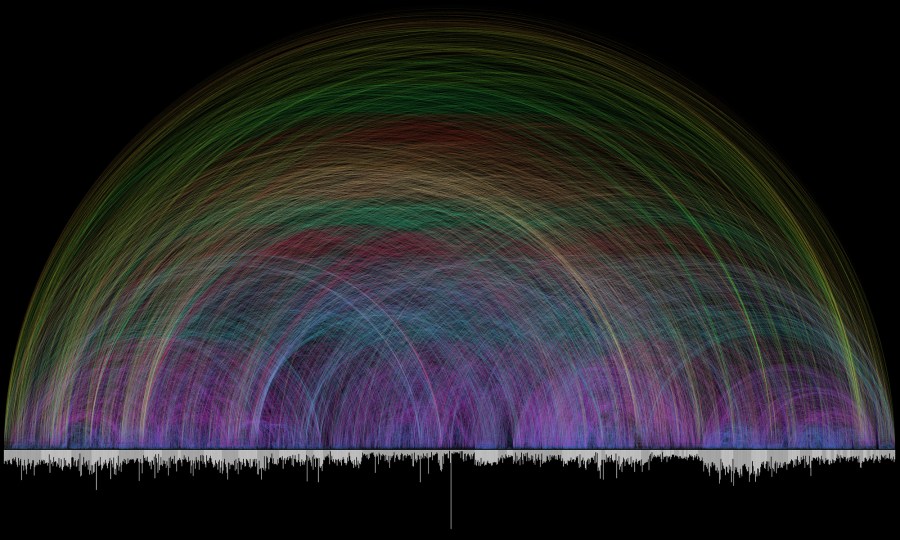
Visualizing the Bible® Chris Harrison. Used by permission. This image was named one of the best science images of 2008 in National Geographic News. Chris explains: “The bar graph that runs along the bottom represents all of the chapters in the Bible. Books alternate in color between white and light gray. The length of each bar denotes the number of verses in the chapter. Each of the 63,779 cross references found in the Bible is depicted by a single arc – the color corresponds to the distance between the two chapters, creating a rainbow-like effect.” If you’d like a print, Chris sells it at Etsy here. As the longest chapter in the Bible, it’s easy to find Psalm 119 on the chart. Look for the longest thin line extending down from the bar graph.
1,8Alec Motyer, Psalms By The Day: A New Devotional Translation (Christian Focus Publications Ltd, Ross-shire, Scotland, U.K. 2016) 331, 335.
2,3,5,6,7Derek Kidner, Psalms 73–150 (Inter-Varsity Press, Leicester, England: 1975) 416, 416–417, 419, 420, 421–422.
4Leslie S. M’Caw, J. A. Motyer, “Psalms,” The New Bible Commentary: Revised, D. Guthrie, J. A. Motyer, eds., A. M. Stibbs, D. J. Wiseman, contributing eds. (Inter-Varsity Press, Downers Grove IL: 1970) 526.
I’m using Michael Coley’s Bible reading plan (one page PDF to print) to read through the Bible in 2023. Each day my posts are on different books because he divides Bible readings into seven categories, one for each day of the week: Epistles, The Law, History, Psalms, Poetry, Prophecy and Gospels. There’s more information on his plan and other ones at Read the Bible in 2023.
Copyright ©2011–2023 Iwana Carpenter
 Kindling for Candles