
By Wednesday the chief priests, scribes, and elders were plotting to find a way to kill Jesus. Matthew and Mark record that they wanted to do it after Passover because they were afraid the crowds would riot. Robert Thomas and Stanley Gundry write:
“Their schedule of action was accelerated, however, when they received an unexpected offer of cooperation from one of the twelve…This enabled them to arrest Jesus privately…In this way God’s predetermined schedule for the Lamb of God to be slain on the Passover, and not after, (Matt. 26:2) was kept.”1
It is no coincidence that Jesus’ crucifixion took place at Passover, because the Passover lamb of Exodus was a type of Jesus Christ Norton Sterrett writes that, “a type is a divinely purposed, Old Testament foreshadowing of a New Testament spiritual reality.”2
The first Passover occurred during the last of the ten plagues that God brought upon Egypt. Exodus 11–12 describes this last plague. The final plague, the death of the firstborn of both people and cattle, is also the best known of the ten. In Exodus 12, God gave explicit instructions to Moses and Aaron for the first Passover: the Hebrews were to put the blood of a slain, unblemished male lamb on the two doorposts and lintel of their homes.
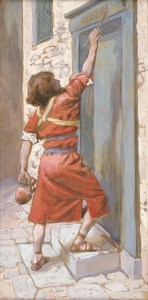 Then Moses called for all the elders of Israel and said to them, “Bring out and take for yourselves lambs according to your families and slaughter the Passover lamb. And you shall take a bunch of hyssop and dip it in the blood which is in the basin, and touch some of the blood that is in the basin to the lintel and the two doorposts; and none of you shall go outside the doorway of his house until morning. And Yahweh will pass through to smite the Egyptians; and He will see the blood on the lintel and on the two doorposts, and Yahweh will pass over the doorway and will not allow the destroyer to come into your houses to smite you. And you shall keep this event as a statute for you and your children forever.”
The Passover lamb anticipated the Lamb of God. The Passover lamb was slain so that God would pass over the people of a house marked with blood and not visit them with a judgment of death. The New Testament writers make it clear that the Passover lamb was a type of Jesus Christ. John the Baptist calls Jesus the Lamb of God who takes away the sin of the world, the Apostle Paul calls Jesus our Passover Lamb, and in Revelation Jesus is called the Lamb twenty-seven times!
This week we remember the death of the Lord Jesus for His people and celebrate His Resurrection. God passes over those who believe in His Son and does not visit us with the judgment we deserve for our sins because Jesus Christ, our Passover Lamb, was slain for us.


The Signs on the Door: James Tissot. Public Domain.
First Born Plague: J. M. W. Turner. Public Domain.
Death of the Pharaoh’s firstborn son (Ex. 12:29): Lawrence Alma-Tadema. Public Domain.
Agnus Dei: Francisco de Zurbarán. Public Domain.
LSB: Legacy Standard Bible New Testament with Psalms and Proverbs (Steadfast Bibles, Irvine CA: 2021).
1Robert L. Thomas and Stanley N. Gundry, A Harmony of the Gospels (HarperSanFrancisco: 1978) 205.
2T. Norton Sterrett, How To Understand Your Bible (InterVarsity Press, Downers Grove IL: 1974) 109. For further explanation see Edmund Clowney’s discussion of type and antitype in Peter’s reference to Noah in 1 Peter 3 as quoted in my post on Noah, Genesis 8–11: Flood & Fire.
Copyright ©2014–2025 Iwana Carpenter
 Kindling for Candles