
Read the Bible in 2023 ◊ Week 21: Sunday
 Therefore I am well content with weaknesses, with insults, with distresses, with persecutions and hardships, for the sake of Christ, for when I am weak, then I am strong.
Sunday’s Bible reading of 2 Corinthians 11–13, finishes Paul’s letter. He knows the areas of weaknesses in which they need strengthening, and as he has some strong and urgent exhortations for them as he closes his letter. From his great love and deep concern for them he continues to address looking on ourward appearances, boasting, deception, and their mistaken ideas of strength and weakness.
Weakness and strength are key thoughts in Paul’s letter; he has honestly written to them of his own affliction and burdens (2 Corinthians 1, 2 Corinthians 4, 2 Corinthians 6, 2 Corinthians 7, 2 Corinthians 11, and 2 Corthians 12, ). He writes of the Lord Jesus:
2 Corinthians 12:1–10, could serve as a lens through which to view 2 Corinthians with its interwoven themes of love and suffering in the fabric of ministry.
 Because of the surpassing greatness of the revelations, for this reason, to keep me from exalting myself, there was given me a thorn in the flesh, a messenger of Satan to torment me—to keep me from exalting myself! Concerning this I pleaded with the Lord three times that it might leave me. And He has said to me, “My grace is sufficient for you, for power is perfected in weakness.” Most gladly, therefore, I will rather boast in my weaknesses, so that the power of Christ may dwell in me.
In Jeremiah 17–21: Judgment & Faithfulness, I quoted Francis Schaeffer from his book, Death in the City, as he alludes to 2 Corinthians 12:9.
“So many people seem to think that if the Holy Spirit is working then the work is easy. Don’t believe it! As the Holy Spirit works, a man is consumed. This is the record of revivals; it is the record of those places in which God has really done something. It is not easy!
“As I stand and try to give a message into the world—at the café tables and in the universities, to individuals and large seminars, publicly and privately—a price has to be paid. Often there is discouragement. Many times I say, “I can’t go up the hill once more. I can’t do it again.” And what is God’s answer? Well, first it is important to know that God doesn’t scold a man when his tiredness comes from his battles and his tears from compassion. Second, this involves learning to say, and mean, “Lord, please make your strength perfect in my weakness.”
“Jeremiah, we recall, was the weeping prophet. This has psychological depth as well as historic meaning. He is really the man weeping. But what does God expect of Jeremiah? What does God expect of every man who preaches into a lost age like ours? I’ll tell you what God expects. He simply expects a man to go right on. He doesn’t scold a man for being tired, but neither does He expect him to stop his message because people are against him. Jeremiah proclaimed the message to the very end.”1
Jeremiah proclaimed his message to the end, and so did Paul. A prophet who wept and despaired. An apostle who knew sorrow and depression. Both sustained by God in His lovingkindness and compassion; both faithful unto death.
What about us? We are also earthen vessels and having God’s treasure it does not mean we no longer weep or never tire; the surpassing greatness of the power is of God and not from ourselves. These truths are very clear in this letter. We cannot forget them or deny them, for if we do we will either grow proud or falter under our own strength. We must help each other, and as Schaeffer urged, learn to say and mean, Lord, please make your strength perfect in my weakness.

Silvesterzug Laterne: Bk muc. (CC BY-SA 4.0).
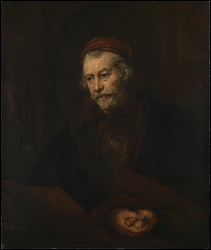
The Apostle Paul: Rembrandt.
1Francis Schaeffer, “The Persistence of Compassion,” Death in the City (Inter-Varsity Press, Downers Grove IL: 1969) 69–70.
I’m using Michael Coley’s Bible reading plan (one page PDF to print) to read through the Bible in 2023. Each day my posts are on different books because he divides Bible readings into seven categories, one for each day of the week: Epistles, The Law, History, Psalms, Poetry, Prophecy and Gospels. There’s more information on his plan and other ones at Read the Bible in 2023.
Copyright ©2011–2023 Iwana Carpenter
 Kindling for Candles