
Read the Bible in 2023 ◊ Week 32: Monday
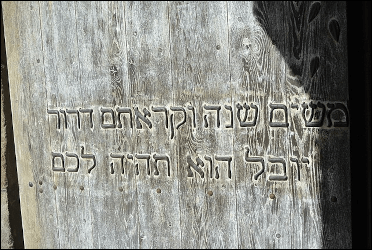
 “You shall thus set apart as holy the fiftieth year and proclaim a release through the land to all its inhabitants. It shall be a jubilee for you, and each of you shall return to his own possession of land, and each of you shall return to his family.”
Monday’s Bible reading of Leviticus 25–27 finishes the book of Leviticus.
Leviticus 25 contains the laws for the sabbatical year and the jubilee year. The word jubilee is not a translation from the Hebrew, but rather a transliteration of the Hebrew word.1,2 Ralph Alexander writes:
“…this noun in Lev and Num is never translated, but transliterated by the word “jubilee.” The context of these passages is the “year of jubilee: when the land lies fallow, all possessions (especially the land, its produce, and slaves) revert to the original owners, and produce is provided for the people by Yahweh’s blessing upon the land in the previous year, therefore it seems that the derivation of “jubilee” is probably from yābal “to bring (forth).” The produce is “brought forth” to provide for the fallow jubilee year, and property is “brought” or “returned” to the original owners. The “year of jubilee” begins with the blast of the shōpār on the Day of Atonement each fiftieth year. It is a year that is holy (separated) unto Yahweh (Lev. 25:10–15).”3
As you read, look at how these laws would have taught the nation of Israel about who God is and who they were. Observing the sabbatical year and the jubilee year would have required faith and trust in God for His provision. If you could not sow or reap, then there would be no harvest to eat until the year following the sabbatical year, and in the case of the jubilee year there would have been no harvest until the year following the back-to-back combined sabbatical and jubilee years. God promised Israel:
Derek Kidner writes:
“However sound the principle of the fallow year, it would invite disaster to observe it everywhere simultaneously (as the chapter seems to require), but for the divine promise of vs. 20–22 (cf. 26.10). The jubilee year, with two fallow years in succession (11), intensified the test of faith to an extreme; for the whole ordinance meant taking one’s hands off the basic things of life, to concede that they were primarily God’s. This was too much for pre-exile Israel, whose land had to wait for captivity to enjoy its sabbaths (26.34 f.: 2 Chron. 36.21).”4
Oswald Allis comments on these verses:
“20 And if you say, ‘What shall we eat in the seventh year?’ This seems to imply that the hypothetical objectors have the sabbatical year only in mind. But the answer includes the larger problem as well, the case when the sabbatical year is followed by the jubilee. 21, 22 This is indicated by the mention of three years and of the eighth and ninth years. The answer of the greater difficulty includes, of course, the solution of the lesser.”5
Observing the sabbatical year would have taught Israel in a very real way their complete dependence on God for sustaining their very lives. They would also have repeatedly seen with their own eyes the goodness and faithfulness of God in sustaining their lives!
The jubilee year would have reinforced this lesson of dependence even more strongly. It would have given them such encouragement to obey God and trust Him for all the details of their lives when they saw they had food to eat even when they had not sown or reaped for several years.
The jubilee year was a “year of liberty.”6 The King James Version of the Bible translates proclaim a release through the land as proclaim liberty throughout all the land. Ezekiel 46:17 refers to it as the year of liberty.

The jubilee year gave a hopeful future to the poor and to the slaves; people knew a year was coming when they could redeem their land, their possessions, or themselves. Obeying the jubilee laws would have also ensured fair treatment and kept avarice and greed in check. They would have known that the land and the people belonged to God.
Chapter 26 contrasts obedience and the consequent great blessings through which God will confirm His covenant, with disobedience and the severe consequences of breaking God’s covenant. It closes by saying:
Kidner titles Leviticus 26, “A Concluding Charge to Israel,”7 and writes:
“This appeal was to be echoed, forty years later, in the parting words of Moses, where its substance is re-shaped into the blessings and cursings that clinch a covenant [cf. Deuteronomy 27–28].”8
Chapter 27 gives the laws regarding votive offerings and tithes. This is the last verse of Leviticus:
Allis has this to say about 27:34.
“The closing statement is briefer and less definite than that of 26:46. It may be regarded, therefore, as referring primarily to ch. 27 and not to the entire book.”9
Kidner concurs, titling Leviticus 27, “An Appendix on Valuations.”10
One of the great surprises I’ve had from reading the Bible is how much I like the book of Leviticus. This started years ago when we were reading through it with our son when he was finishing high school. I expected to be weighed down by legalism, but instead I saw the marvel of God’s goodness unfolding in His Law.
I want you to see the value and significance of this Old Testament book for us as Christians. From it we we see God’s holiness and righteousness reflected in His moral law. We see His concern for fair treatment and His compassion. We also learn about our sinful nature and the necessity of atonement for sin. Leviticus would have shown these things over and over again to the Israelites.
Leviticus teaches us about God’s holiness, love, and grace in making a way for sinful man to approach and worship the living God. Leviticus gives me a greater understanding of Psalm 19, and how David could write those descriptions of God’s Law. Leviticus helps me to sing the song with more insight and with more joy than I have ever had.
 The law of Yahweh is perfect,
Sweeter also than honey and the drippings of the honeycomb.
In keeping them there is great reward.
Who can discern his errors? Acquit me of hidden faults.
Also keep back Your slave from presumptuous sins;
Let them not rule over me;
Then I will be blameless,
And I shall be acquitted of great transgression.
Let the words of my mouth and the meditation of my heart
Be acceptable in Your sight,
O Yahweh, my rock and my Redeemer.

Silvesterzug Laterne: Bk muc. (CC BY-SA 4.0).
Church of Saint-Malo, Dinan, France: Door inscribed with part of Leviticus 25:10. I think it’s the middle part of the verse: …the fiftieth year…proclaim a release. It shall be a jubilee for you. Colsu. (CC BY-SA 4.0).
Jewish National Fund (J.N.F.) stamp tab: Inscription on tab: “…the land shall not be sold for ever…” Leviticus XXV, 23. Issued: June 24, 1951. Stamp cropped to its inscription. Public Domain.
Honey: http://www.ipernity.com/home/kurtsik (CC BY-SA 3.0).
1“transliteration. n. A word that has been rendered in another language by substituting the corresponding letters of the alphabet rather than translating the meaning of the word (Lat. “across letter”). E.g., the word baptism is derived by transliteration from βαπτίξω.” DeMoss, Matthew, Pocket Dictionary for the Study of New Testament Greek (InterVarsity Press, Downers Grove IL: 2001) 124–125.
In DeMoss’ example of the word baptism, the letter, b, is substituted for the Greek letter, β (beta). a is substituted for α (alpha). p is substiuted for π (pi). t is substituted for τ (tau). i is substituted for ι (iota). sm is a noun ending substituted for ξ (xi). The final Greek letter, ω (omega), is the Greek noun ending.
2,3Ralph H. Alexander, “835e יוֹבֵל (yôbēl), יבֵל (yobēl) trumpet,” Theological Wordbook of the Old Testament, vol. I, R. Laird Harris, Gleason L. Archer, Jr., Bruce K. Waltke, eds. (The Moody Bible Institute, Chicago IL: 1980) 359.
4,7,8,10Derek Kidner, Leviticus, Numbers and Deuteronomy, Scripture Union Bible Study Books (William B. Eerdmans Publishing Company, Grand Rapids MI: 1971) 28, 29, 29, 30.
5,6,9Oswald T. Allis, “Leviticus,” The New Bible Commentary: Revised, D. Guthrie, J. A. Motyer, eds., A. M. Stibbs, D. J. Wiseman, contributing eds. (Inter-Varsity Press, Downers Grove IL: 1970) 167.
See also R. C. Sproul, “Which Laws Apply?” April 25, 2017, Copyright by Ligonier Ministries. This is very helpful post by R. C. Sproul on the “the role of the law of God in the Christian life.”
I’m using Michael Coley’s Bible reading plan (one page PDF to print) to read through the Bible in 2023. Each day my posts are on different books because he divides Bible readings into seven categories, one for each day of the week: Epistles, The Law, History, Psalms, Poetry, Prophecy and Gospels. There’s more information on his plan and other ones at Read the Bible in 2023.
Copyright ©2021–2023 Iwana Carpenter
 Kindling for Candles