
Read the Bible in 2023 ◊ Week 32: Tuesday

Kenan, Mahalalel, Jared,
Enoch, Methuselah, Lamech,
Noah, Shem, Ham, and Japheth…
Eber, Peleg, Reu,
Serug, Nahor, Terah,
Abram, that is Abraham.
The sons of Abraham were Isaac and Ishmael…
The sons of Isaac were Esau and Israel.
Tuesday’s Bible reading is 1 Chronicles 1–4. 1 Chronicles begins the postexilic historical books of the Old Testament. Gleason Archer writes this in his introduction to 1 and 2 Chronicles:
“The purpose of these two volumes is to review the history of Israel from the dawn of the human race to the Babylonian captivity and Cyrus’ edict of restoration. This review is composed with a very definite purpose in mind, to give to the Jews of the Second Commonwealth the true spiritual foundation of their theocracy as the covenant people of Jehovah. This historian’s purpose is to show that the true glory of the Hebrew nation was found in its covenant relationship to God…Always the emphasis is upon that which is sound and valid in Israel’s past as furnishing a reliable basis for the task of reconstruction which lay ahead. Great stress is placed upon the rich heritage of Israel and its unbroken connection with the patriarchal beginnings (hence the prominence accorded to genealogical lists).”1
 The chapters in today’s reading begin the genealogies of Israel. Reading through name after name can be heavy going. In his commentary on Ruth, Leon Morris writes about the importance of genealogy. I hope it will be an encouragement to you as you read.
“Why does the book end with a genealogy?… The author does not tell us why he has done this, and we are left to guess. But at any rate we can make this comment. Throughout the book in all its artless simplicity there runs the note that God is supreme. He watches over people like Naomi and Ruth and Boaz and directs their paths. God never forgets His saving purposes. The issue of the marriage of Boaz and Ruth was to lead in due course to the great King David, the man after God’s own heart, the man in whom God’s purpose was so signally worked out. These events in Moab and Bethlehem played their part in leading up to the birth of David. The Christian will also think of the genealogy at the beginning of the Gospel according to St. Matthew. He will reflect God’s hand is over all history. God works out his purpose, generation after generation. Limited as we are to one lifetime, each of us sees so little of what happens. A genealogy is a striking way of bringing before us the continuity of God’s purpose through the ages. The process of history is not haphazard. There is a purpose in it all. And the purpose is the purpose of God.”2
Remember this: A genealogy is a striking way of bringing before us the continuity of God’s purpose through the ages. Watch for names you recognize. Look also for patterns. For example, look back again at 1 Chronicles 1:1–4 and 1:24–28.
Kenan, Mahalalel, Jared,
Enoch, Methuselah, Lamech,
Noah, Shem, Ham, and Japheth…
Eber, Peleg, Reu,
Serug, Nahor, Terah,
Abram, that is Abraham.
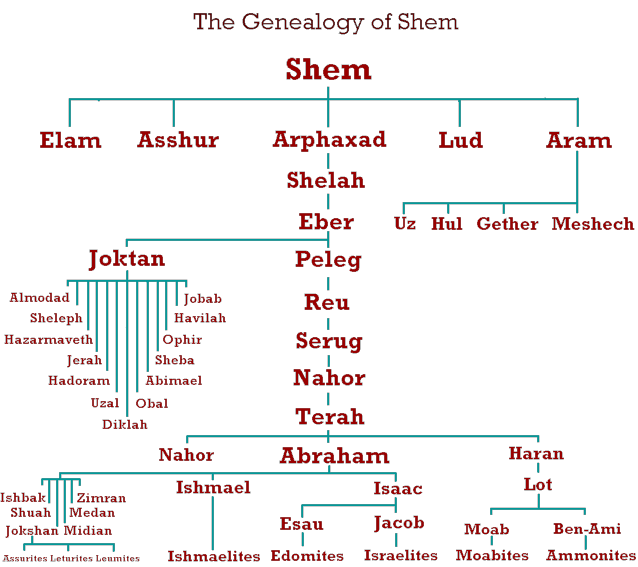
Verse 4 ends with Noah and his sons: Shem, Ham and Japheth. In the following verses the descendants of each of the three sons are names. Then in verse 24, the genealogy goes back to pick up the direct line from Shem to Abraham.
Next, after naming Abraham’s sons, Ishmael and Isaac, some of Ishmael’s descendants are named, and then Isaac’s sons Esau and Israel (Jacob). Some of Esau’s descendants are given and mention of kings of Edom. Chapter 2 then goes back to Israel, and begins the genealogies of his twelve sons. As you can see some lines are dropped because God’s covenant with Abraham was established with Isaac and Israel.
Chapters 2–8 are genealogies of the twelve tribes, but they begin with Judah because David is from the tribe of Judah.
If you find it too much to read so many names in one sitting (as I do!), then read through a family group and note familiar names and any omissions, and come back again later. Remember the importance these genealogies would have had for those who had been in exile, probably most of whom would never before have seen the land of Israel (cf. Ezra 3:12) that God had given to Abraham, Isaac and Jacob.

Silvesterzug Laterne: Bk muc. (CC BY-SA 4.0).
The genealogy of Shem to Abraham: Drnhawkins. (CC BY-SA 3.0). GFDL-1.2-or-later. Click the image to enlarge. The author of this genealogy states it is from Genesis. Your translation may use different spellings for some of the names. You can compare yours with the KJV or AKJV translation at BibleGateway.
1Gleason L. Archer, Jr., “Postexilic Historical Books: 1 and 2 Chronicles, Ezra, Nehemiah, Esther,” A Survey of Old Testament Introduction (Moody Press, Chicago IL: 1974) 404.
2Leon Morris, Ruth: An Introduction and Commentary (Inter-Varsity Press, Downers Grove IL: 1968) 317–318.
I’m using Michael Coley’s Bible reading plan (one page PDF to print) to read through the Bible in 2023. Each day my posts are on different books because he divides Bible readings into seven categories, one for each day of the week: Epistles, The Law, History, Psalms, Poetry, Prophecy and Gospels. There’s more information on his plan and other ones at Read the Bible in 2023.
Copyright ©2011–2023 Iwana Carpenter

