
Read the Bible in 2023 ◊ Week 34: Tuesday

Tuesday’s Bible reading is 1 Chronicles 10–14. Chapter 10 has a very brief record of Saul’s last battle as king of Israel, and his death (cf. 1 Samuel 31). Beginning with chapter 11, the rest of 1 Chronicles is about the reign of David.
You’ll notice that only Saul’s death is recorded. Other details of Saul’s life and his persecution of David are omitted. Remember that 1 and 2 Chronicles are post-exilic books and as such have a different purpose in writing about the history of Israel. H. L. Ellison gives this perspective on Chronicles:
 “The ‘Chronicler’ is obviously writing history, for there is a very clear principle both in his additions to Samuel and Kings and in his omissions. His additions concern mainly the Temple and its services and such incidents as exalted the religious side of the state in contrast to the civil. Obviously he is concerned mainly with Israel as a religious community. His omissions show that he is concerned with the development of two divine institutions, the Temple and the Davidic line of kings. Hence only the death of Saul is mentioned: his reign, David’s sin, Absalom’s rebellion, Adonijah’s attempted usurpation are all omitted. The history of the northern kingdom, which was in rebellion against both of God’s institutions, is mentioned only where it touches the fortunes of Judah.
“That is why Chronicles is said to represent the priestly standpoint; it is concerned with the working out of what God has ordained and not, as Samuel and Kings, with the prophetic standpoint of how God dealt with His people and so revealed Himself.
“The reasons for the writing of Chronicles are not far to seek. The post-exilic community had to understand how it had come into existence, that it was a true continuation of the pre-exhilic kingdom (hence the genealogies), and what was the role of God’s gift, the Temple and its services, that had been entrusted to them. The omission of so many familiar scenes from Samuel and Kings underlined that, though those that had returned from exile were few in number, God had always been eliminating from the history of His people that which was in rebellion against Him.
“In an age when there is an ever-growing tendency to abandon the old revelation of God in the Scriptures, Chronicles has its lesson of encouragement and warning for us.”1
1 Chronicles 11 begins with David being anointed as king at Hebron and then the rest of today’s reading records David’s military might and leadership, with these traits underscored by the sheer numbers of men he lead and their exploits in battle. Because other events of his life are omitted, David as a warrior comes to the forefront, as his strength and ability to lead men, who in and of themselves were mighty men, into battle are described. As the events unfold, God’s hand in establishing David as king of Israel is clearly seen and recorded.

Silvesterzug Laterne: Bk muc. (CC BY-SA 4.0).
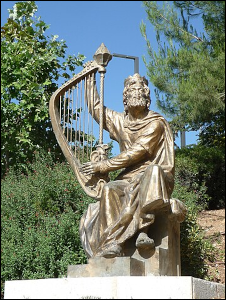
King David on Zion: Immanuel Giel. (CC BY-SA 4.0).
1H. L. Ellison, “1 and 2 Chronicles,” The New Bible Commentary: Revised, D. Guthrie, J. A. Motyer, eds., A. M. Stibbs, D. J. Wiseman, contributing eds. (Inter-Varsity Press, Downers Grove IL: 1970) 369.
I’m using Michael Coley’s Bible reading plan (one page PDF to print) to read through the Bible in 2023. Each day my posts are on different books because he divides Bible readings into seven categories, one for each day of the week: Epistles, The Law, History, Psalms, Poetry, Prophecy and Gospels. There’s more information on his plan and other ones at Read the Bible in 2023.
Copyright ©2011–2023 Iwana Carpenter
 Kindling for Candles